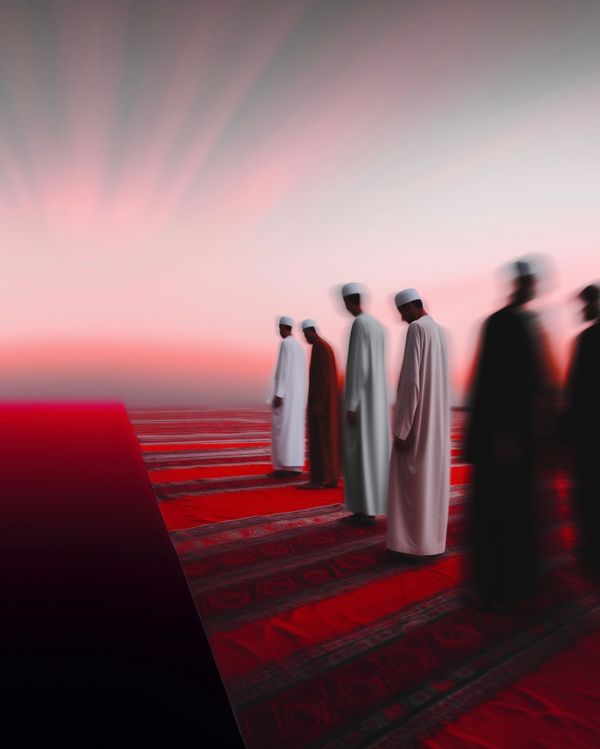
Virtue of Namâz in Jamâ’at
Supposing someone performed a namâz of two rak’ats in jamâ’at and a namâz of twenty-seven rak’ats on his own, the namâz of two rak’ats that he performed in jamâ’at would still yield more thawâb.
According to another riwâyat (scholarly tradition), even if the namâz he performed consisted of a thousand rak’ats, two rak’ats of namâz performed in jamâ’at would still earn him more thawâb. There is plenty of thawâb in performing namâz in jamâ’at. Here are a few of its benefits:
1– When Believers come together, they will love one another.
2– Ignorant ones will learn about matters concerning namâz from learned ones.
3– If the namâz performed by some of them is acceptable while others’ namâz is not, the unacceptable namâz of the latter group will be accepted for the grace of the acceptable namâz of the former.
A hadîth-i-sherîf reads: “O my Ummat and my Sahâba! I have put forth two paths for you: One of them is the Qur’ân al-’adhîm ush-shân, and the other one is my Sunnat. A person who follows a path other than these two is not my Ummat!” [’Abd-ul-Ghânî Nablusî ‘rahima-hullâhu ta’âlâ’ (1050 [1640 A.D.], Damascus – 1143 [1731]) states as follows in the ninety-ninth page of his book entitled Hadîqa (and which is a commentary to the book entitled Tarîqat-i-Muhammadiyya and written by Imâm Birgivî): While Allâhu ta’âlâ announced a part of Islam by way of the Qur’ân al-kerîm, He announced its other part throught the Sunnat of His blessed Prophet ‘sall-Allâhu ’alaihi wa sallam’. The Sunnat of Rasûlullah consists of his beliefs, utterances, practices, moral behaviour, and his tacit admission of someone’s act or statement, [which was construed as his accepting (what had been done or said).]” This hadîth-i-sherîf indicates the second one of the (four Islamic sources called) Edilla-i-shar’iyya.]
Imâmat in Namâz (in Jamâ’at)
There are four kinds of people following the imâm (who is conducting namâz in jamâ’at): Mudrik, Muqtedî, Mesbûq, and Lâhiq.
1– Mudrik is a Muslim who makes the takbîr iftitâh together with the imâm. (In other words, he says, “Allâhu ekber,” (almost) at the same time as the imâm does so, which in turn means that he has started to perform the namâz in jamâ’at together with the imâm conducting the namâz in jamâ’at.)
2– A Muslim who fails to catch up with the takbîr iftitâh is called muqtedî.
3– Mesbûq is a Muslim who (joins the jamâ’at and) starts to follow the imâm after the imâm has performed one or two rak’ats of the namâz.
4– Lâhiq is a Muslim who made the takbîr iftitâh together with the imâm; however, he has undergone a state of hadas, (he has somehow lost his ablution;)1 he makes an ablution and resumes his namâz behind the imâm. This Muslim performs the namâz exactly as he did when he was behind the imâm, (i.e. he does not make qirâat, but he makes the Rukû, the Sajda and the tasbîhs during them.) If he has not uttered any words pertaining to worldly matters (as he leaves the mosque to renew his ablution), it is the same as if he performed the entire namâz behind the imâm and together with the imâm. However, after leaving the mosque (for the purpose of renewing his ablution), he ought to make an ablution at a place nearest the mosque. There are Islamic scholars who state that his namâz will become fâsid if he goes too far away.
If a person finds the imâm making the Rukû’ as he enters the mosque and, in the hurry of catching up with the imâm, makes the takbîr iftitâh as he bends down for the Rukû’, he has not followed the imâm, (i.e. he has not joined the jamâ’at.) If he, when he finds the imâm making the Rukû’, makes his niyyat to follow the imâm, makes the takbîr (iftitâh) completely within the standing position, then bends down for the Rukû’ and says the tasbîh as the imâm is still in the position of Rukû’, he has caught up with the imâm (and joined the jamâ’at) within that rak’at. Yet, if the imâm straightens up as this Muslim bends down for the Rukû’, he has not caught up with that rak’at.
Dipnotlar
- Please see the second chapter of the fourth fascicle of Endless Bliss for ‘hadas’. ↑
Ta’dîl-i-Arkân in Namâz
If a person skips (observing) the ta’dîl-i-arkân at five places of namâz, not forgetfully but deliberately, his namâz becomes fâsid (null and void) according to Imâm Abû Yûsuf ‘rahima-hullâhu ta’âlâ’. According to the Tarafeyn (Imâm A’zam Abû Hanîfa and Imâm Muhammad), it does not become fâsid, but then it will be necessary for him to reperform the namâz for the purpose of making up for an imperfection arising from the negligence of an act that is wâjib. Sajda-i-sahw will be necessary when you fail to observe it forgetfully. [Please review the section of the current book dealing with the causes of losing one’s îmân!]
Skipping the ta’dîl-i-arkân engenders some twenty-six harms:
1– It causes poverty.
2– ’Ulamâ (savants) of the Hereafter hate you.
3– You fall from ’adâlat, so that you will no longer be acceptable as a witness.
4– The place where you perform that (imperfect) namâz will bear witness against you on the Rising Day.
5– A person will be sinful for not (kindly and with due tact and finesse) warning another person whom he sees to perform namâz without the ta’dîl-i-arkân.
6– You have to reperform the namâz (which you performed without observing the ta’dîl-i-arkân).
7– It causes dying without îmân.
8– It makes you a thief who steals from namâz.
9– The namâz you have performed will be flung like an old rag to your teeth on the Day of Judgment.
10– You will be deprived of the Mercy of Allâhu ta’âlâ.
11– You will have behaved improperly in your supplication to Allâhu ta’âlâ.
12– You will be deprived of the plenty of thawâb inherent in namâz.
13– It causes the thawâbs that you are to be given for your other acts of worship to be withheld.
14– It causes you to deserve Hell.
15– It causes ignorant people who see you to (follow your bad example and) disignore the ta’dîl-i-arkân. It is for the same matter that sinning on the part of a man of religion will incur more torment.
16– You will have opposed your imâm.
17– You will have omitted the sunnats at the intiqâlât (transitions).
18– You will incur Wrath of Allâhu ’adhîm-ush-shân.
19– You will have pleased the Satan.
20– You will be far from Paradise.
21– You will be close to Hell.
22– You will have been cruel to your own nafs.
23– You will have made your own nafs dirty.
24– You will have hurt the angels on your right and left.
25– You will have saddened Rasûlullah ‘sall-Allâhu ’alaihi wa sallam’.
26– You will have caused harm to the entire creation. For, on account of your sin, there will be no rains and crops, or there will be unseasonable rains, which will cause harm to crops, instead of nourishing them.